Game Review
Big Walk Review: The Co-op Hike That Makes Talking Matter
Big Walk turns a shared hike into one of 2026's strongest co-op puzzle games, with excellent communication design, real group magic, and a few practical caveats.
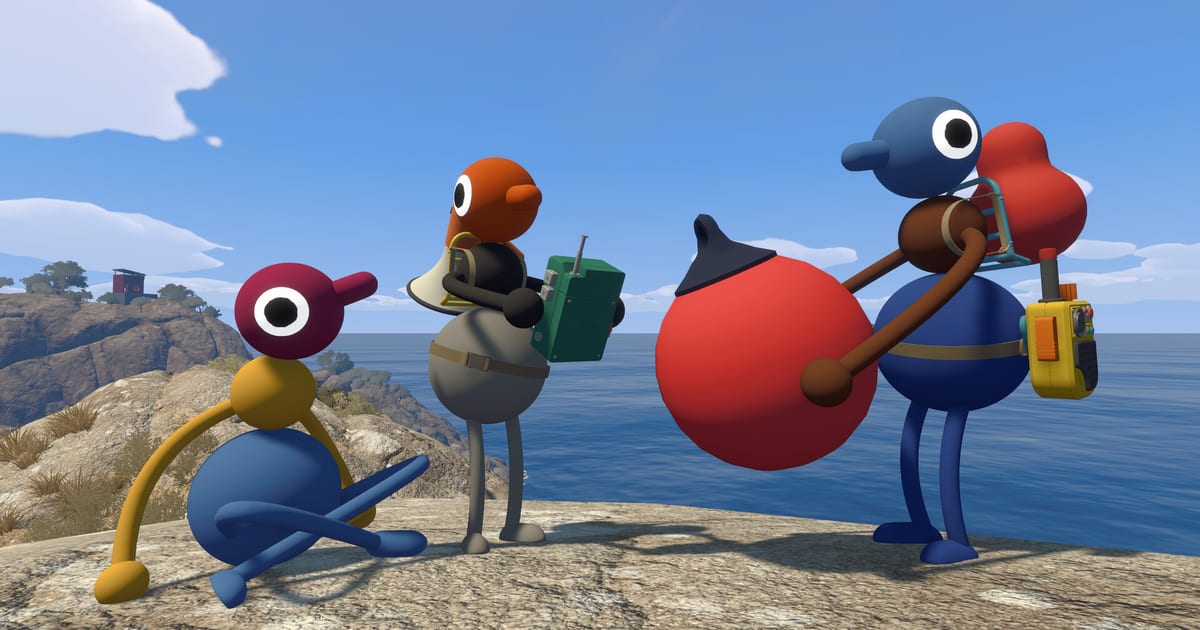
Big Walk is a game about getting separated from your friends and realizing the panic is the point. It looks quiet from a distance: strange little characters, bright toy-like tools, cliffs, bushes, ocean, puzzles, and a world that seems built for wandering. Then someone walks out of earshot, the group loses the plan, and a simple hike turns into a full Discord incident.
That is the hook. House House, the studio behind Untitled Goose Game, did not make another prank machine. Big Walk is warmer, weirder, and more committed to cooperation. It asks players to use the game's own proximity voice and text systems, not a clean outside voice channel, because the friction of not always hearing each other is where most of the design lives.
The verified facts are strong. Big Walk launched on August 4, 2026, from developer House House and publisher Panic. Steam lists it as an Adventure game with online co-op, cross-platform multiplayer, Steam achievements, Steam Cloud, Windows and macOS support, and a $19.99 USD base price with a $14.99 introductory sale price at the time of this review. The official FAQ lists Windows, Mac, PlayStation 5, and Nintendo Switch 2, confirms two to twelve players, confirms crossplay, and clearly says there is no single-player mode and no online matchmaking.
The community signal is also loud. Steam currently shows Very Positive English reviews, while SteamDB tracks a large launch audience, thousands of positive reviews, and an all-time Steam peak above 46,000 concurrent players. Critics have broadly landed in the same place: Big Walk is one of the year's standout co-op games, but it asks for the right group, the right patience, and a willingness to let the game control communication.
This review is based on verified Steam information, the official Big Walk site and FAQ, SteamDB data, official update notes, current player feedback, and reputable critical coverage, not a claimed completed PUG Empire playthrough.
Let's break it down using our comprehensive 10-point rating system.
What is Big Walk?
Big Walk is a cooperative online adventure from House House and Panic. The official pitch calls it a game about teamwork and talking, and that is accurate. You and at least one friend enter a wide-open island world, explore at your own pace, solve physical and communication-driven puzzles, collect progress items, unlock routes, and gradually turn an aimless hike into a shared campaign.
The important detail is that communication is not just a convenience. It is the mechanic. Voices fade with distance, get blocked by spaces, and travel through tools such as walkie-talkies. Text chat follows similar rules. Gestures, pointing, carrying, flailing, and improvised signals matter because the game keeps creating situations where clean voice comms are unavailable or incomplete.
Quick Facts:
- Game: Big Walk
- Developer: House House
- Publisher: Panic
- Release Date: August 4, 2026
- Platforms: Windows and Mac via Steam, PlayStation 5, Nintendo Switch 2
- Price: $19.99 USD base price, $14.99 introductory Steam sale price at review time
- Genres: Adventure, co-op puzzle, exploration
- Players: 2 to 12 online, no single-player mode
- Steam: Big Walk on Steam
How we score this review
Before we lock in the verdict, here's how we evaluate every game that crosses our radar:
- Gameplay Mechanics (1.0 point) - How does it feel to play?
- Graphics & Visual Design (1.0 point) - Does it look good?
- Audio & Sound Design (1.0 point) - How's the audio experience?
- Story & Narrative (1.0 point) - Is there a compelling story?
- Replayability (1.0 point) - Will you keep coming back?
- Multiplayer/Social (1.0 point) - How's the online experience?
- Performance & Optimization (1.0 point) - Does it run well?
- Innovation & Originality (1.0 point) - Does it bring something new?
- Value for Money (1.0 point) - Is it worth the price?
- Overall Fun Factor (1.0 point) - Bottom line: is it fun?
Now let's see whether this walk is worth organizing the squad.
1. Gameplay Mechanics: 0.88/1.00
Big Walk succeeds because its basic verbs are simple, but the group context keeps them interesting. You walk, climb, point, carry, use tools, solve puzzles, lose people, reconnect, and slowly build a shared understanding of the island. The mechanical depth is not in a combo list or progression tree. It is in how the game turns communication into problem-solving.
What Works:
- Proximity voice and text are core mechanics, not gimmicks
- Puzzles are built around cooperation instead of one player doing everything
- Tools such as walkie-talkies, binoculars, flares, signs, and megaphones create funny solutions
- The world supports wandering, discovery, and shared navigation
- Group-size variants help puzzles work with different crew sizes
- Challenge skipping and accessibility options reduce hard blockers
Current Friction:
- Walking and backtracking can become the least interesting part
- No solo mode means the game is useless without another player
- No online matchmaking puts all group organization on the players
- The host owns progression, so the same host needs to return for continuity
- Some players will bounce off the lack of direct objectives
The design has confidence. Big Walk does not constantly tell the group where to go or what to think. That makes discoveries feel earned, and it makes dumb group theories part of the fun. The tradeoff is obvious: if your group wants waypoints, combat, loot, or constant forward pressure, the hike can feel too loose.
For the right crew, though, the mechanics are excellent. Big Walk makes talking, listening, pointing, and misreading the plan feel like actual play.
Score: 0.88/1.00 - Smart co-op systems with some pacing and organization friction.
2. Graphics & Visual Design: 0.90/1.00
Big Walk has one of the cleaner visual identities of the year. The island can look strangely natural, with cliffs, scrub, coastlines, darkness, water, and wide open space, while the characters and puzzle structures look like toy-box objects that escaped into the wilderness.
Visual Highlights:
- Strong contrast between realistic terrain and goofy player characters
- Colorful tools and puzzle objects are easy to read
- Day, night, and distance change how players navigate
- The island feels spacious without turning into visual noise
- Character silhouettes are instantly recognizable in a group
That contrast is not just style. It helps the game function. When someone points at a landmark, a colored structure, a cliff, or a tool, the group can usually parse the subject quickly. In a communication-first game, readability is not optional.
The criticism is that the world can also feel sparse by design. Big Walk wants downtime, hiking, and silence between puzzles, but a player looking for dense collectible maps or constant visual rewards may read that space as emptiness.
Still, the overall presentation is memorable, coherent, and immediately identifiable.
Score: 0.90/1.00 - Distinct, readable, and beautiful in a quiet, odd way.
3. Audio & Sound Design: 0.92/1.00
Audio is Big Walk's backbone. The whole game depends on how voices fade, crackle, echo, disappear, and return. That system turns distance into drama and makes proximity feel physical.
Audio Strengths:
- Proximity voice chat gives space real consequences
- Walkie-talkies and other tools change how groups coordinate
- Environmental sound supports the hiking mood
- Puzzle success feedback gives small wins a social punch
- The soundtrack, credited officially to AKSFX, supports the game's gentle weirdness
- Text chat mirrors the same distance-based design for players who do not use microphones
The early technical conversation around audio is worth noting. Some players complained that voices were too quiet, and House House has already released version 1.4.8 to address quiet microphone setups without expanding the distance at which voices carry. That is the right kind of fix: improve clarity while preserving the rules that make the game interesting.
The result is one of the rare games where using Discord on top of the game can actively make the experience worse. Big Walk wants communication to be fragile, funny, spatial, and sometimes broken. The audio design understands that.
Score: 0.92/1.00 - Excellent communication design, with launch voice-volume issues already being addressed.
4. Story & Narrative: 0.68/1.00
Big Walk is not a traditional story game. It has a beginning, middle, and end according to the official FAQ, but the emotional center is not a cinematic plot. It is the shared memory of what your group found, misunderstood, solved, and ruined.
Narrative Notes:
- The world has mystery without heavy exposition
- Player discovery carries more weight than scripted drama
- The campaign structure gives the group a real destination
- The best stories come from getting lost, separated, and reunited
- There is limited authored character or plot depth
This is the right narrative shape for Big Walk. A louder story would probably get in the way. The game needs room for players to argue about symbols, yell over a hill, lose the person with the useful item, and then remember the whole thing later as if it were a trip that actually happened.
That earns credit for emergent narrative and tone. It does not earn the same score as a strong story-driven RPG.
Score: 0.68/1.00 - Strong shared stories, modest authored narrative.
5. Replayability: 0.82/1.00
Replayability depends on what you want from the game. Big Walk is officially a hand-crafted adventure meant to be played start-to-finish with a group, not an endless live-service treadmill. That limits pure repeat value, but it also makes the experience cleaner.
Replay Factors:
- Different group sizes change the world setup
- New players can make familiar puzzles feel different
- The island supports hanging out beyond strict progression
- Large groups create chaos that smaller groups avoid
- Strong word-of-mouth makes it easy to become a community event
Replay Concerns:
- Puzzle knowledge reduces surprise on repeat runs
- Host-based progression can complicate group schedules
- No matchmaking limits casual replay with strangers
- Players who want loot or progression systems may not return after finishing
The best use case is obvious: get a group, commit to a few sessions, and treat Big Walk like a shared campaign. It is not trying to be a forever game. It is trying to be a memorable thing your group actually finishes.
That is good replayability, but not unlimited replayability.
Score: 0.82/1.00 - Strong group-event value, with finite handcrafted content.
6. Multiplayer/Social: 0.96/1.00
This is the category Big Walk was built to dominate. It is multiplayer-first in the purest sense: not "more players equals more damage," but "more players equals more language, more confusion, more memory, and more ways for the plan to fall apart."
Social Strengths:
- Two to twelve players support focused duos and messy larger groups
- Crossplay lowers platform friction across Steam, PS5, and Switch 2
- In-game communication creates real spatial comedy
- Puzzles require participation instead of passive tagging along
- Carrying, pointing, gesturing, and tool use make nonverbal moments useful
- The game is built for friends, not random matchmaking churn
For a PUG-style community, Big Walk is extremely relevant. It gives people a reason to gather, talk, solve, tease, regroup, and keep a running list of "remember when" moments. That is the exact fuel a Discord game needs.
The only serious multiplayer penalty is practical. No matchmaking is an intentional design choice, but it still means the game depends on you having friends ready to play. The host-save model also means groups need to coordinate who keeps the session alive.
Those caveats matter. They do not change the bigger point: Big Walk is one of the sharpest social co-op designs on Steam right now.
Score: 0.96/1.00 - Outstanding co-op design for groups willing to play by its rules.
7. Performance & Optimization: 0.80/1.00
Big Walk's technical condition looks solid overall, but not invisible. Steam user sentiment is extremely positive, which suggests most players are getting stable sessions, and the official system requirements are reasonable for a modern 3D co-op game. Steam lists Windows and macOS support, while the official site also confirms console availability.
Technical Positives:
- Very Positive Steam user response across a large review pool
- Official crossplay support
- Version 1.4.8 already targets quiet voice issues
- Settings include control rebinding, FOV on PC and Mac, and motion reduction overlays
- Official FAQ gives practical troubleshooting for framerate, networking, controllers, and voice chat
Technical Concerns:
- Voice volume was a visible launch complaint
- Network quality and host performance can affect other players
- No matchmaking means connection flow depends on friend lists or join codes
- Some players report pacing and traversal annoyances rather than pure bugs
The key question is whether Big Walk can survive a normal game night. The answer appears to be yes, with the usual warning that voice, network, and host setup matter more than they do in a solo game.
Score: 0.80/1.00 - Generally healthy, with voice and network caveats that matter in a communication game.
8. Innovation & Originality: 0.93/1.00
Big Walk is not innovative because it has co-op or puzzles. It is innovative because it trusts communication friction enough to build a whole adventure around it.
Fresh Elements:
- Voice range is part of the puzzle design
- Text chat follows spatial limitations instead of acting like a global escape hatch
- Tools change how players communicate, not just what buttons they press
- The game treats downtime and wandering as part of friendship
- It rejects the normal pressure to make every second efficient
There are obvious comparison points: co-op puzzle games, walking sims, open-world discovery, proximity chat chaos, and hangout games like PEAK. Big Walk still feels distinct because its tone is gentler and its design is more deliberate. It is less about panic survival and more about collaborative understanding.
That is rare. Plenty of games say they are about teamwork. Big Walk makes teamwork the controller.
Score: 0.93/1.00 - A genuinely fresh co-op structure built around communication.
9. Value for Money: 0.88/1.00
At $19.99 USD, Big Walk is priced fairly for a handcrafted co-op adventure. At the current $14.99 introductory Steam sale price, the value is very strong if you already have a group ready.
Value Proposition:
- Low enough price for a group buy
- Crossplay helps mixed-platform friend groups
- Strong critical and Steam user consensus
- Enough structure for a multi-session campaign
- A very clear identity with little direct competition
Value Caveats:
- No solo mode means no fallback experience
- No random matchmaking hurts players without a ready group
- Repeat value depends on how much your group enjoys revisiting known puzzles
- Some players may prefer subscription access or a sale if only one night is likely
This is a great value for a committed group and a bad value for a lonely impulse purchase. That sounds harsh, but it is also the game's own position. Big Walk is not trying to serve everyone.
For PUG Empire squads, the math is strong. If four or more people are ready to commit, this is one of the easier $20 recommendations of 2026.
Score: 0.88/1.00 - Excellent group value, limited by the lack of solo and matchmaking options.
10. Overall Fun Factor: 0.94/1.00
Big Walk is fun because it makes very normal group behavior feel meaningful. Someone wanders off. Someone explains a symbol badly. Someone insists the group is going the wrong way and is absolutely wrong. Someone figures out the puzzle and becomes unbearable for three minutes. Someone steals the binoculars. Somehow, the walk continues.
Fun Highlights:
- Great shared discovery
- Funny failures that rarely feel cruel
- Strong "one more puzzle" energy
- Excellent fit for voice-chat communities
- Works as both a puzzle game and a hangout space
- The best moments sound like real friends solving nonsense together
The big warning is that Big Walk needs buy-in. If people treat the in-game communication limits as an annoyance to bypass, the design loses teeth. If players want combat, loot, or constant objectives, the pace may feel too gentle.
But if the group accepts the premise, Big Walk can create the kind of night most multiplayer games are only pretending to offer.
Score: 0.94/1.00 - A standout co-op hangout game with real puzzle satisfaction.
Final Verdict: 8.71/10.00
Breakdown:
- Gameplay Mechanics: 0.88/1.00
- Graphics & Visual Design: 0.90/1.00
- Audio & Sound Design: 0.92/1.00
- Story & Narrative: 0.68/1.00
- Replayability: 0.82/1.00
- Multiplayer/Social: 0.96/1.00
- Performance & Optimization: 0.80/1.00
- Innovation & Originality: 0.93/1.00
- Value for Money: 0.88/1.00
- Overall Fun Factor: 0.94/1.00
Total: 8.71/10.00
The Bottom Line
Big Walk is one of the clearest co-op recommendations of 2026, but only for the right kind of group. It is not a solo game, not a matchmaking game, and not a loot treadmill. It is a handcrafted adventure about getting lost with people you know, using imperfect communication to solve problems that become fun because the humans are messy.
The strengths are obvious: excellent communication design, strong puzzle cooperation, a distinct visual style, crossplay, fair pricing, and the kind of community-night energy that can keep a Discord talking after the session ends. The weaknesses are also real: no solo mode, no matchmaking, host-save friction, some walking/backtracking drag, and early voice-volume complaints that House House has started patching.
That leaves Big Walk in a strong place. It is not for everyone, but it is very, very much for groups that like puzzles, wandering, jokes, and the slow realization that maybe Discord was the wrong tool all along.
Pros:
- Excellent communication-first co-op
- Strong puzzle design
- Two to twelve players with crossplay
- Distinct visual identity
- Great group storytelling
- Fair price, especially during the launch sale
- Useful accessibility options
Cons:
- No single-player mode
- No online matchmaking
- Host-based progress can complicate schedules
- Walking and backtracking can drag
- In-game voice setup matters a lot
- Players who bypass communication limits lose part of the design
Recommendation: Big Walk is a must-consider pickup for squads that want a cooperative adventure built around talking, listening, miscommunication, and shared discovery. Skip it if you need solo value, random lobbies, constant combat, or a game that tells you exactly what to do every minute.
Bring friends. Use the in-game chat. When someone says they know the way, start taking notes.
Have you taken the Big Walk with your squad? Drop your best wrong turn, strangest puzzle theory, or loudest walkie-talkie moment in our Discord and tell us what we should review next.
Final Score: 8.71/10.00 - Big Walk is a brilliant co-op hike that turns talking, distance, and confusion into one of the year's best group games.
Behind this article
Sources & editorial notes
This is a research-based editorial review. It draws on published information and the sources below, and does not claim a completed hands-on playthrough.
Editorial standards & correctionsShare this article

Written by
ApexInterfectum
Co-Founder, PUG Empire | Army Veteran | Full Stack Developer
ApexInterfectum is an Army veteran and co-founder of PUG Empire, a competitive gaming community built on coordinated team play and continuous improvement. He brings a full-stack development background to community tooling and content infrastructure, and serves as technical subject matter expert across the Dirty Rice platform. His writing covers the systems and strategies behind sustainable content creation, competitive growth, and modern streaming workflows.