Opinion
Xbox Cloud Gaming Caps: Asha Sharma's Player-First Pitch Falls Apart
Xbox plans to meter Game Pass cloud play from November. For Asha Sharma, a 15-hour Ultimate allowance is an embarrassing answer to promises of putting players first.

Asha Sharma's Xbox wants credit for putting players first. Its cloud-gaming announcement deserves the opposite: a hard look at how cheaply that promise can be traded away when the bill comes due.
This is a lousy deal for affected cloud players and an embarrassing test of Sharma's leadership. A subscription should make an evening of gaming simpler, not introduce another balance to check before joining your friends. Xbox is asking players to accept an experience where the company gets its recurring payment, while the customer gets a recurring question: how much gaming is left?
That is not an exciting vision for the future of play. It is an accounting problem handed to the audience with a familiar logo attached. And it deserves considerably more scrutiny than a sympathetic nod toward infrastructure costs.
Opinion and news analysis. Banner: supplied satirical artwork, not documentary photography. The article is written by ApexInterfectum, not Asha Sharma.
What Xbox Is Changing
Starting in November 2026, Xbox's announced monthly cloud allowances are:
| Game Pass plan | Included cloud playtime per month |
|---|---|
| Ultimate | 15 hours |
| Premium | 10 hours |
| Essential | 5 hours |
Subscribers who exhaust their allowance can buy extra hours. The official announcement does not specify those prices. It also introduces paid cloud access without Game Pass for eligible owned games. These restrictions concern cloud streaming, not time spent playing installed games.
The distinction matters. Nobody should walk away believing an Xbox console will shut down every game after fifteen hours. The criticism is narrower and stronger: customers who rely on streaming face a materially different proposition from those who can simply install what they want to play.
What Fifteen Hours Actually Buys
An allowance looks generous or stingy depending on the life you put around it. So put an ordinary gaming schedule around this one.
Imagine a group that plays for three hours on Friday and another three on Sunday. Over four weeks, that is 24 hours. An affected Ultimate subscriber relying entirely on cloud play would have nine hours beyond the announced allowance. That is a hypothetical schedule, not a claim about average player behavior, but it shows how quickly a perfectly plausible routine becomes an extra purchase.
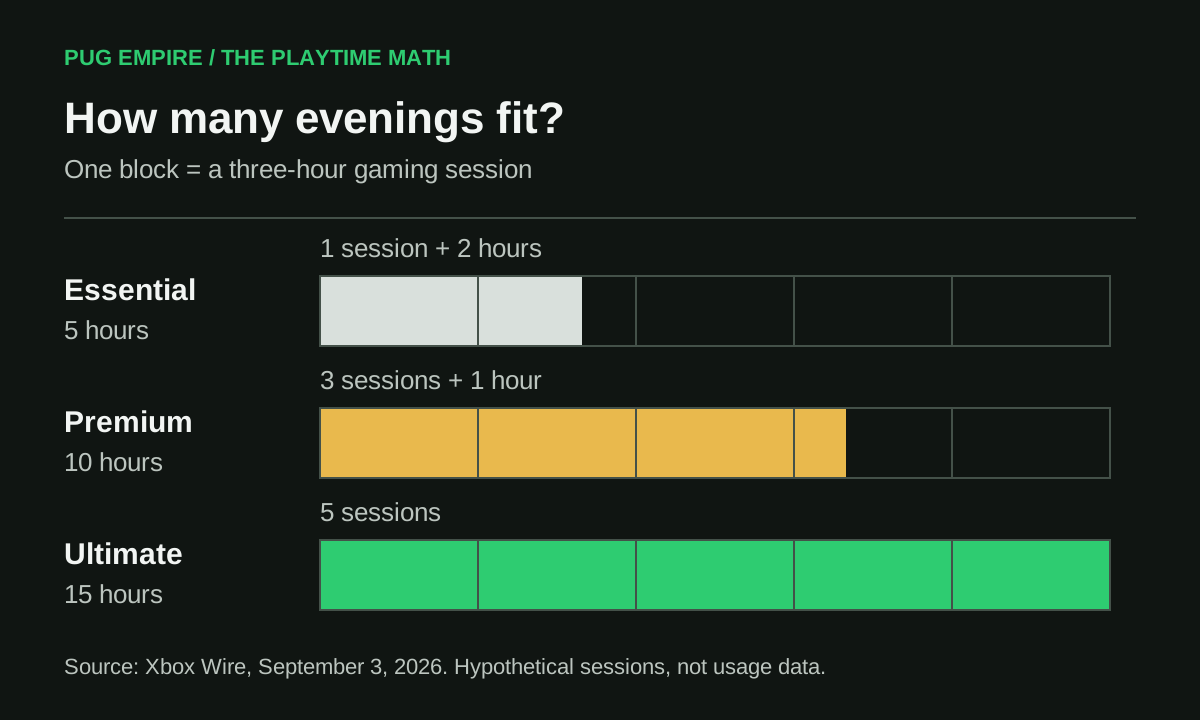
The smaller plans make the tradeoff sharper. Five hours is one three-hour evening plus two hours toward the next. Ten hours gets three complete evenings and an hour left over. Fifteen gets five. You do not need to be treating gaming like a second job to find those numbers restrictive.
Now consider the small decisions that make games enjoyable: exploring a side area, helping someone finish a mission, trying a character you might not keep, or staying online because a friend finally arrived. None is necessarily the best use of a tightly rationed allowance. All can be a good use of an evening.
That is the experiential cost a pricing table misses. The meter changes the question from "Am I enjoying this?" to "Is this worth spending my remaining time on?" For a subscription built around access, that is an ugly compromise. Calling the highest allowance "Ultimate" only makes the compromise sound more absurd.
Sharma's Own Words Set the Standard
In her introductory message as CEO, Sharma promised renewed commitment to Xbox fans. She also said the company would not treat its worlds as "static IP to milk and monetize."
Those words were a welcome statement of priorities. They are also a standard she should be held to, not a promotional speech everyone politely forgets when an awkward announcement arrives. Nobody forced her to frame this job around renewed commitment to players. Having chosen that language, she should expect customers to ask what it means when the product becomes less useful to them.
The public record does not establish that Sharma personally devised these limits. It does establish that she leads the business implementing them. Executive accountability does not require pretending we were in the meeting.

If she wants the credit for Xbox's direction, she can answer for its tradeoffs. On this one, the player-first pitch falls flat. A CEO's job is not merely to approve reassuring language. It is to make decisions that give that language substance.
There is a difference between making an unpopular decision and making an indefensible one. Good leadership explains what was considered, what customers gain, and why the chosen compromise is preferable. It does not expect the audience to fill the gaps with brand loyalty. Sharma should be doing that difficult work in public. Until the case is convincing, the promises deserve skepticism rather than applause.
Costs Are Real. So Is the Downgrade.
Microsoft cites rising operating costs and estimates that 4% of Game Pass subscribers will be affected. That estimate covers the subscriber base, not specifically regular cloud users. It does not tell us how much of that audience will run out. Source: Xbox Wire.
A small percentage is not a moral discount on customer frustration. Players do not become disposable because they fit into a smaller column on a spreadsheet.
Nobody needs to pretend servers run for free. Capacity, maintenance, and the basic challenge of serving simultaneous players are legitimate business considerations. A sustainable service is better than an unsustainable promise. A serious criticism should concede that much without surrendering the argument.
But explaining an expense is not the same as demonstrating that this particular solution is fair. What makes these allowances appropriate? What alternatives were considered? How much predictable monthly use can a customer reasonably buy? Those are product questions, not demands that Microsoft suspend arithmetic.
The percentage is also a poor substitute for understanding the affected customers. A person who barely streams and a person who depends on streaming have very different relationships with this feature. Combining them in one subscriber-wide number can describe the business accurately while telling an individual reader very little about their own exposure.
The Interface Says the Quiet Part Clearly
Xbox's published illustration places a remaining-time balance beside an option to purchase more playtime. It is a useful visual explanation of the announced model, not proof that the rollout has already reached every account.
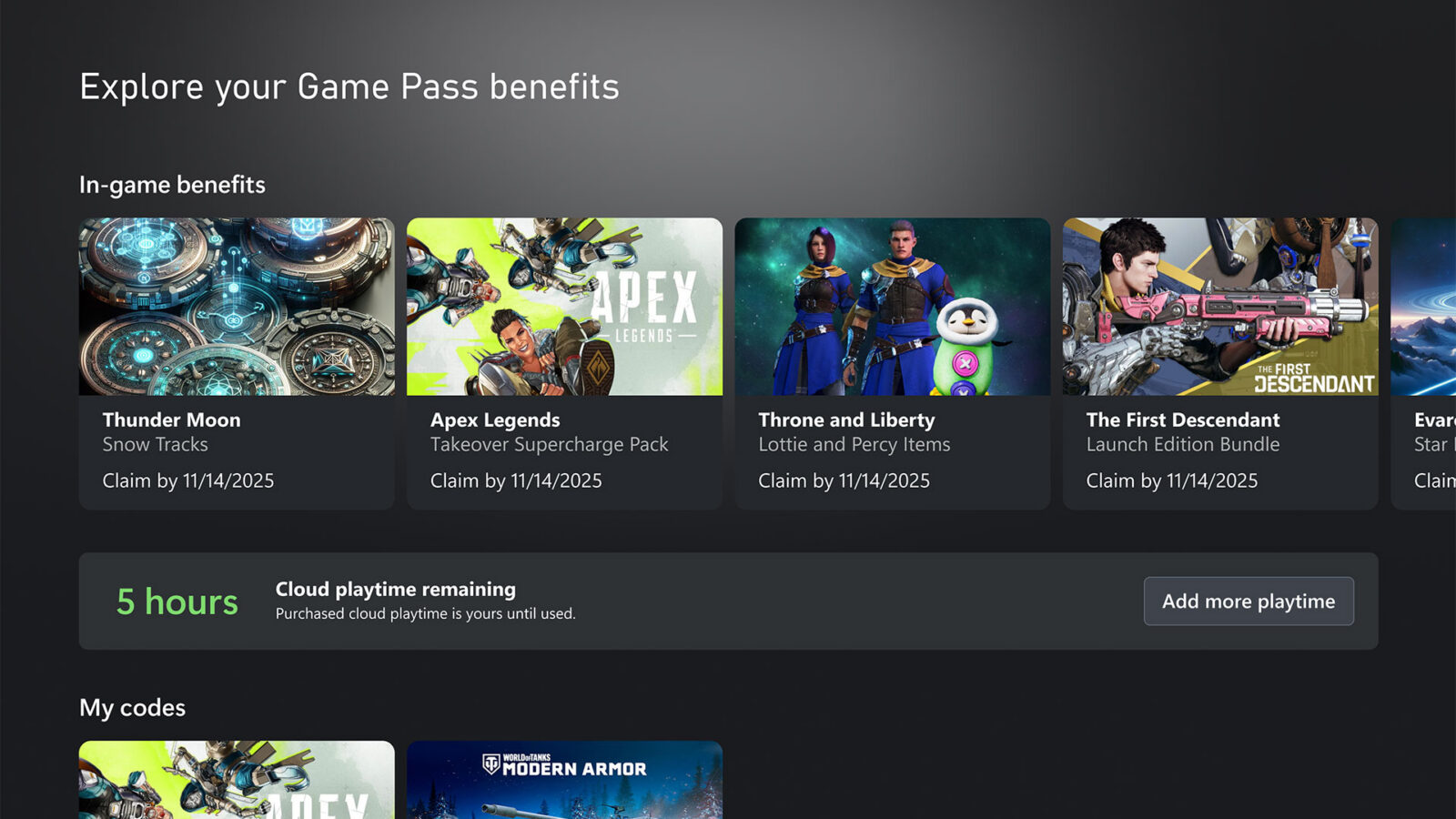
For me, that interface captures the problem more clearly than the announcement's business language. A service that should disappear into the background of an evening instead puts the remaining allowance in the foreground. The friction is not only the eventual charge. It is the anticipation of it.
There is a perfectly reasonable place for optional, occasional pay-as-you-go access. Someone who wants a short burst of streaming might welcome it. That does not make reducing an existing subscription benefit equally welcome. Adding a new purchasing option and shrinking an old allowance are separate decisions. The first does not excuse the second.
The Exceptions Matter
T3 reports that existing subscribers in Australia, Brazil, Poland, and Germany have received notices preserving unlimited access while qualifying recurring subscriptions continue. New subscriptions, or cancellation followed by rejoining, can be treated differently. Check your account's notice: this is not an identical change for every subscriber worldwide.
That distinction matters. Criticizing Xbox does not require erasing facts that complicate the headline. It also means a friend in another country may not be a reliable guide to what happens to your account.
For affected readers, the practical question is not whether an exemption exists somewhere. It is whether their own plan retains the benefit, under what conditions, and what happens if the subscription changes. Those answers should be easy to find before a purchasing decision, not reconstructed from a patchwork of reports and customer emails.
What Sharma Owes Players Before November
The response should be more substantial than another assurance that feedback matters. Here is the standard I would apply to any company making this change:
- Give customers a complete bill to evaluate. Publish extra-hour prices and any purchasing increments alongside the allowances. A customer cannot judge value with half the equation missing.
- Explain the treatment of existing subscriptions. State eligibility and regional differences plainly. Put the answer where the affected subscriber can actually see it.
- Make the meter trustworthy. Explain what counts as billable playtime, how interrupted sessions are handled, and how people dispute an incorrect balance. These are questions that need answers, not allegations that Xbox currently mishandles them.
- Offer meaningful predictability. Consider an option for people whose routine exceeds a small allowance. The specific packaging is Microsoft's job; the customer need is not difficult to understand.
- Defend the decision with customer outcomes. Show why the experience remains worth paying for, rather than treating the company's cost explanation as the end of the discussion.
None of this requires announcing a fantasy product or promising free capacity forever. It requires treating the people paying the bill as participants in the decision, not the final place to put the expense.
Sharma's credibility would be better served by a candid explanation and a revised offer than by allowing her player-first rhetoric to do work the product no longer supports. Changing course after criticism is not weakness. Refusing to improve a weak proposition because it has already been announced would be.
Final Verdict: Earn the Player-First Label
This is not an argument that every business decision must delight every customer. It is an argument that a gaming platform should understand what it is selling. People want access to experiences, time with friends, and the freedom to discover something unexpected. A monthly time allowance can interfere with all three, even when the spreadsheet behind it is internally coherent.
Sharma should reconsider whether this is the relationship Xbox wants with the people who actually use its services. Her leadership should be judged on the offer players receive, not the ambition of the speech introducing it.
PUG Empire's view is straightforward: this is poor customer stewardship dressed as a necessary adjustment. Leadership earns trust by making the difficult case in public and offering a deal worth defending. It loses trust when its biggest promises are followed by smaller benefits.
Xbox does not need a better slogan from Asha Sharma. It needs a better decision.
Behind this article
Sources & editorial notes
This article presents editorial opinion based on the reporting and public statements linked below. Judgments are the author's; factual claims are attributed to their sources.
- Xbox Wire: Upcoming Changes to Xbox Cloud Gaming, September 3, 2026
- Microsoft: Asha Sharma's appointment and commitments to players
- T3: Existing subscriber exceptions in some markets, September 8, 2026
Share this article

Written by
ApexInterfectum
Co-Founder, PUG Empire | Army Veteran | Full Stack Developer
ApexInterfectum is an Army veteran and co-founder of PUG Empire, a competitive gaming community built on coordinated team play and continuous improvement. He brings a full-stack development background to community tooling and content infrastructure, and serves as technical subject matter expert across the Dirty Rice platform. His writing covers the systems and strategies behind sustainable content creation, competitive growth, and modern streaming workflows.